Why we look up?
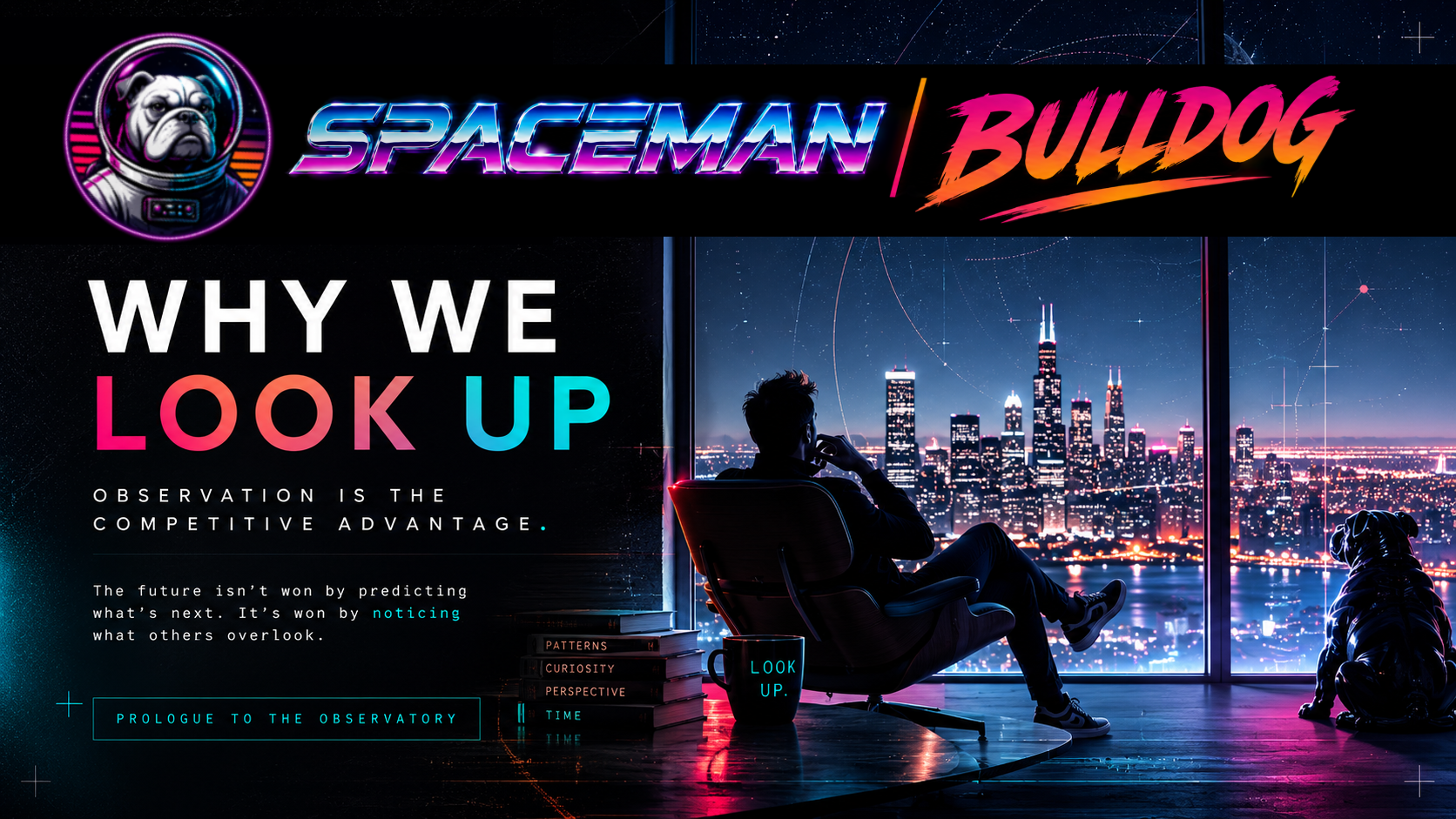
“Observatory”… I have been fixated on that single word.
Not because it sounded different or memorable, but because I couldn't stop thinking about what an observatory actually is. We build them to understand something much larger than ourselves. They are places designed for patience rather than urgency. The people who spend their lives inside them aren't trying to control the stars or predict every movement of the universe. They're trying to notice patterns. They collect observations over years—sometimes decades—knowing that a single night rarely tells the whole story. Only with enough time, with enough curiosity and enough perspective do those observations begin to reveal something meaningful.
For most of my career, I believed the work was about solving problems. That's what organizations hire people to do, after all. A client has a challenge. A team develops a strategy. A process gets redesigned. Technology gets implemented. Another initiative launches. Somewhere along the way, another problem appears, and the cycle begins again. There is nothing inherently wrong with that work. Organizations need people who can execute, make decisions, and keep momentum moving forward.
What I didn't realize until much later was how rarely anyone had the opportunity to step back and ask a different question altogether.
Instead of asking, How do we solve this problem? I started asking, Why does this problem keep showing up in the first place? That single shift in perspective changed everything.
Over the years I've had the privilege of working inside organizations that, on paper, couldn't have looked more different from one another. Some were global enterprises with tens of thousands of employees. Others were small businesses with a handful of people wearing multiple hats just to make it through the week. They served different customers, sold different products, hired different kinds of people, and operated under completely different business models. At first glance, there seemed to be very little connecting them.
Yet after enough conversations, enough transformation efforts, and enough time spent watching leaders wrestle with change, I began noticing something that surprised me. The language was different, but the underlying challenges were remarkably consistent. One company struggled with slow decision-making. Another struggled with culture. A third believed technology was holding them back. Someone else blamed organizational structure. Another blamed communication. On the surface, every problem appeared unique. Beneath the surface, they often traced back to the same patterns.
That realization forced me to rethink almost everything I believed about organizations.
The differences between a Fortune 500 company and a neighborhood business are real, but they are often differences of scale rather than purpose. Large organizations have access to more resources, more specialized talent, and more sophisticated systems. Small businesses operate with tighter budgets and far fewer people. Ironically, those limitations often become strengths. Owners and small teams are forced to understand every part of their business because they don't have the luxury of specialization. They sell, market, hire, manage finances, serve customers, and solve operational problems—sometimes all before lunch.
As organizations grow, expertise increases, but perspective often becomes fragmented. Departments become functions. Functions become silos. Leaders become responsible for narrower slices of increasingly complex systems. Everyone becomes exceptionally good at their own piece of the puzzle, while fewer people can still see the puzzle as a whole.
Eventually I realized that organizations of every size were asking the same fundamental questions. How do we adapt? Where should we invest? What matters now? What will matter next? The circumstances changed. The questions did not.
That observation stayed with me long after individual projects ended. It also made me think differently about the people we often describe as visionaries.
Take Steve Jobs. I don't think he succeeded because he could predict the future. I think he paid attention to signals that other people dismissed. He noticed how technology was changing behavior long before most companies did. He understood that people were no longer buying computers; they were buying experiences. He believed design wasn't something you added at the end of a project—it was part of the product itself. Looking back, those ideas seem obvious. At the time, they challenged the assumptions of an entire industry.
Years later, a young entrepreneur named Melanie Perkins was building a small business around something far less glamorous than personal computing. She was teaching design students and watching them struggle with software that seemed unnecessarily difficult to learn. Most people accepted that frustration as the cost of doing creative work. She didn't. She observed that the real problem wasn't creativity—it was accessibility. If creating a simple presentation or flyer required weeks of training, then the software had become more important than the people it was supposed to serve.
That observation became Canva.
Today, Canva is used by hundreds of millions of people around the world and has become one of the most valuable private technology companies ever built. But it didn't begin with scale, funding, or global ambitions. It began with someone paying close attention to a problem that millions of people had quietly accepted as normal.
One company changed personal computing.
The other changed how the world designs.
The industries were different. The companies were different. Their journeys were different.
The habit was exactly the same.
Neither Steve Jobs nor Melanie Perkins possessed a crystal ball. They simply noticed what everyone else had stopped seeing. They observed before they acted. They recognized patterns before those patterns became trends.
The more I reflected on my own work, the more I realized that the same principle existed inside every successful organization I had encountered. The companies that adapted fastest weren't necessarily the smartest, the largest, or the best funded. They were the ones that paid attention. They noticed subtle changes in customer behavior before competitors did. They questioned assumptions that everyone else accepted. They remained curious long after others had become comfortable.
That's when I realized something that has stayed with me ever since.
It isn't the size of a company that determines its future.
It's the quality of its observation.
That realization became the foundation for The Observatory.
This publication isn't about predicting the future, nor is it a collection of universal business answers. It is a place to step back from the urgency of the moment, look for patterns, connect ideas, and ask better questions. Each Beacon explores observations gathered from organizations, leadership, technology, culture, and human behavior—not because any one observation provides the answer, but because, over time, patterns begin to emerge.
Just as astronomers don't understand the universe by looking at the sky for a single night, we don't understand organizations by reacting only to today's challenges. We understand them by observing over time, connecting seemingly unrelated signals, and remaining curious enough to question what everyone else assumes to be true.
My hope is that these pages encourage you to do the same.
Welcome to The Observatory. I hope you'll look up.