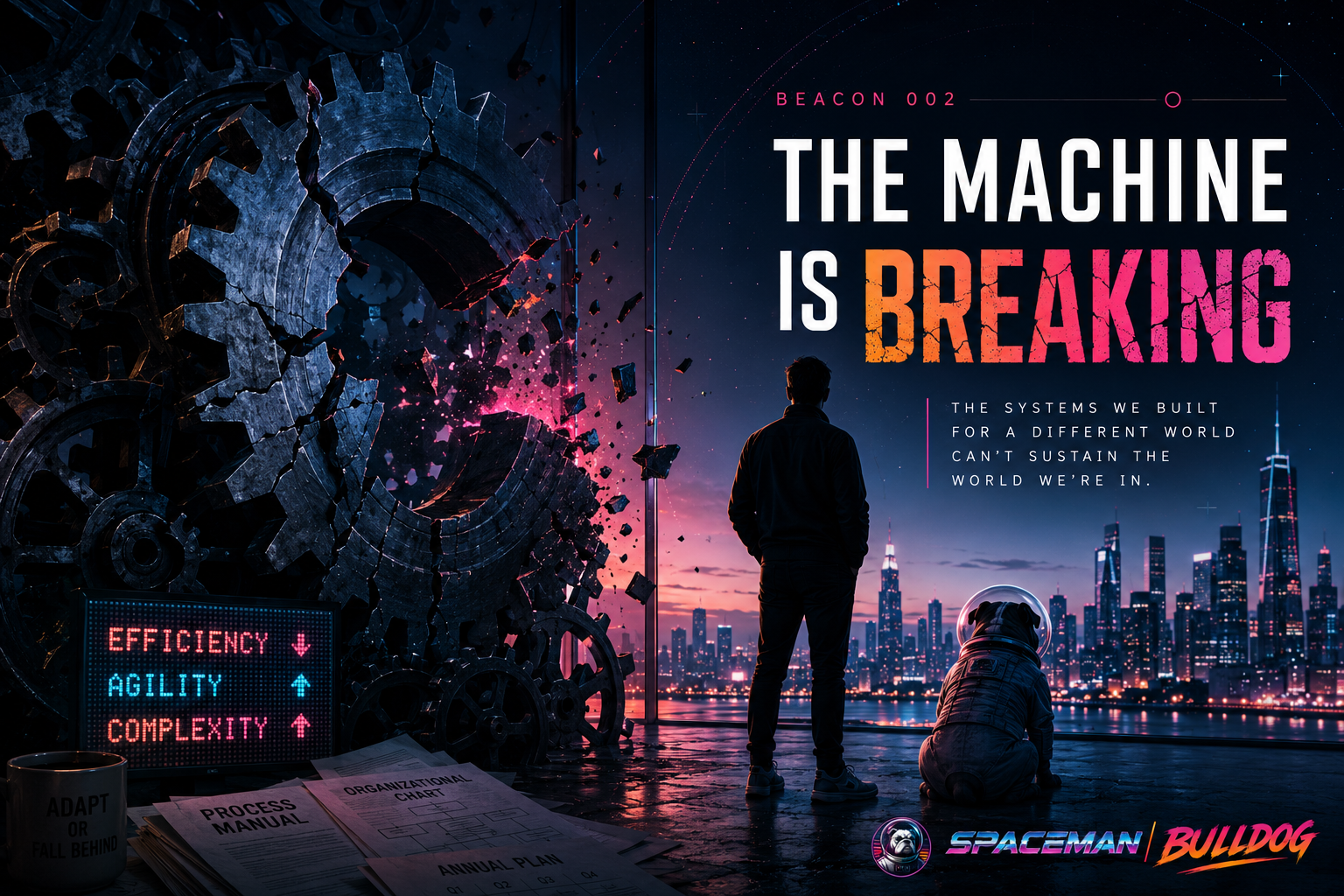
For generations, organizations have been designed around a simple assumption: if every part of the business becomes more efficient, the business itself becomes more successful.
It's a reasonable assumption. We built departments around expertise. We documented processes so work could be repeated consistently. We created reporting structures to improve accountability and management systems to eliminate waste. Entire careers have been devoted to helping organizations operate more efficiently because, for a very long time, efficiency was one of the strongest competitive advantages a company could have.
In many ways, it still is.
The challenge isn't that these ideas stopped working. It's that they were designed for an environment that no longer exists.
For much of the last century, change moved slowly enough for organizations to respond in predictable ways. Markets evolved over years. Competitors were easy to identify. New technologies took decades to become mainstream. Products followed relatively stable life cycles, and annual planning was often sufficient to keep a business on course.
Organizations became incredibly good at optimizing for that reality.
The structures we recognize today—functional departments, hierarchical reporting, annual planning cycles, specialized expertise, carefully managed approval processes—were all logical responses to a world where stability was expected and change was incremental.
The machine wasn't broken.
It was remarkably well engineered.
The problem is that the environment changed while the machine largely stayed the same.
Today, information moves across the globe in seconds. A startup can become a billion-dollar competitor in a matter of years. Customers shift expectations almost overnight. Artificial intelligence is compressing work that once required days into minutes. Communities influence buying behavior more than advertising campaigns, and employees expect organizations to evolve just as quickly as the technology they use every day.
None of those changes happened in isolation. Together, they fundamentally altered the conditions organizations operate within.
Yet many companies continue responding as though the environment hasn't changed.
When performance slows, another approval layer is introduced. When communication breaks down, another meeting appears on the calendar. When priorities become unclear, another dashboard is built. Every new challenge is met with another process intended to restore order.
Individually, those decisions make sense.
Collectively, they often create something else entirely.
Complexity.
I've seen this pattern inside organizations of every size. Large enterprises frequently struggle under the weight of their own success. Every challenge generates another framework, another governance committee, another review process. None of those decisions are irrational on their own, but over time they create organizations that spend increasing amounts of energy coordinating work instead of doing it.
Smaller businesses experience something similar, although it looks different. They often begin with extraordinary agility because everyone understands the whole business. As they grow, they naturally add structure to support that growth. Processes become departments. Departments become functions. Functions become silos. Before long, the organization begins solving yesterday's problems with yesterday's structures while operating in tomorrow's environment.
The irony is that many of these organizations aren't failing because they lack talented people.
They're filled with talented people.
They're filled with hardworking people.
They're filled with experienced leaders.
The challenge is that they're operating inside systems designed for a different pace of change.
Consider what happened when the smartphone became the primary computing device for billions of people.
It didn't simply replace another phone.
It quietly absorbed dozens of industries.
Cameras became applications. GPS devices disappeared into software. Flashlights, calculators, alarm clocks, music players, newspapers, maps, boarding passes, and wallets all found themselves living inside a single piece of hardware.
Most of those industries weren't defeated by better execution.
They were overtaken by a different operating model.
That's an important distinction because it changes how we think about disruption.
Disruption rarely begins with an organization making poor decisions. More often, it begins when the assumptions that made those decisions successful quietly expire.
The same thing is happening inside organizations today.
Artificial intelligence is making knowledge work dramatically more accessible. Digital communities are reshaping trust. Information no longer waits for quarterly meetings to move across an organization. Customers compare experiences across industries rather than within them. Employees collaborate across continents without thinking twice about geography.
These aren't isolated trends.
They're evidence that the operating environment itself has changed.
When the environment changes, organizations have two choices.
They can continue refining the machine they already have, or they can begin designing one that better fits the world they're entering.
That doesn't mean abandoning structure. Organizations still need accountability, clear decisions, and disciplined execution. But those capabilities have to exist alongside adaptability, curiosity, and continuous learning.
The companies that thrive over the next decade won't necessarily have the most sophisticated technology or the most detailed strategic plans.
They'll be the organizations capable of evolving as quickly as the environment around them.
That's a very different kind of advantage.
In the Prologue, I suggested that the future belongs to organizations that observe what others overlook.
This is why.
Before we can redesign how organizations work, we first have to recognize that the systems we've spent decades perfecting were designed for a different era. The goal isn't to discard everything we've built. It's to understand which parts still serve us, which parts no longer do, and what needs to evolve next.
Because the machine isn't failing because people stopped working hard.
The machine is breaking because the world it was built for no longer exists.